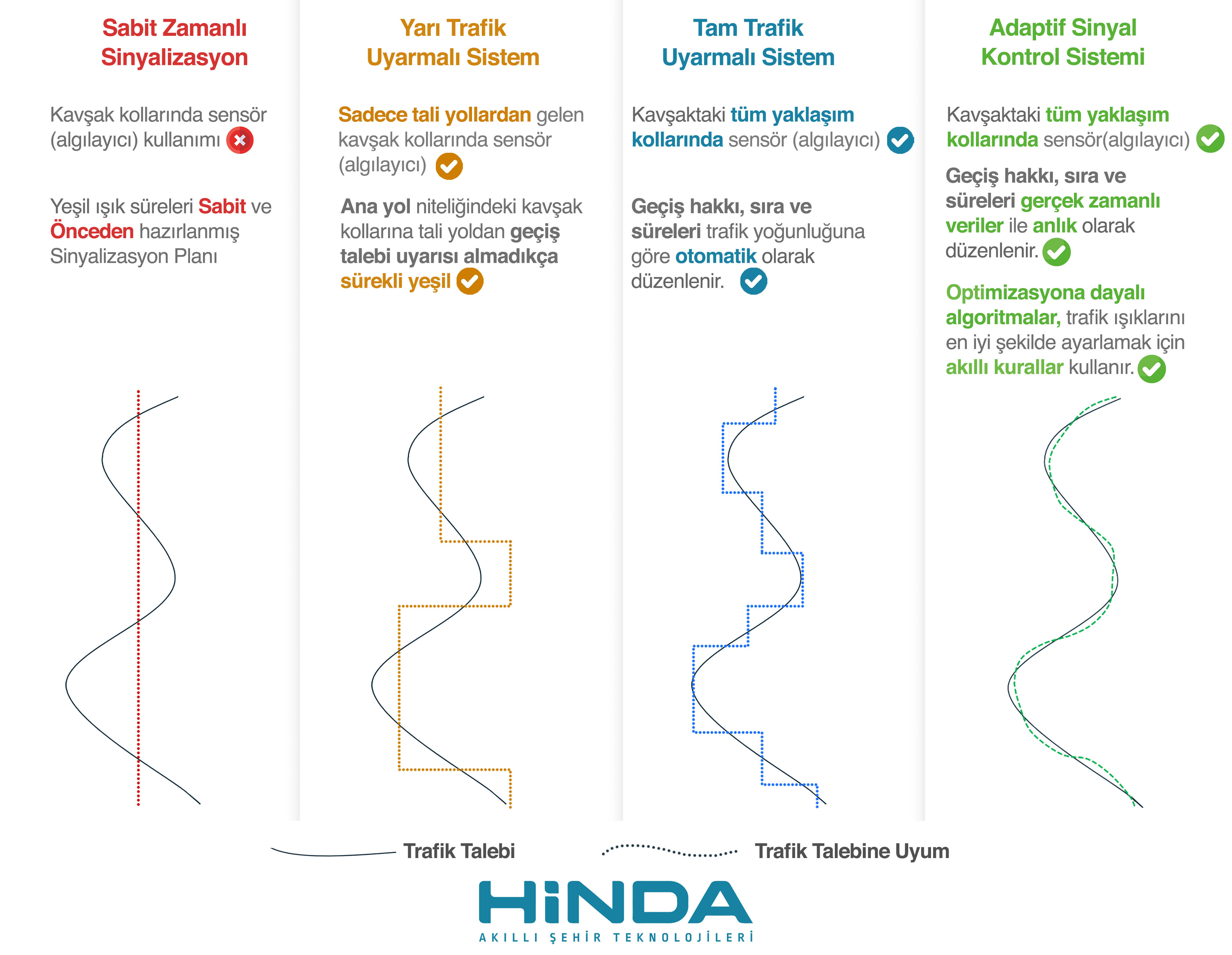
Today, traffic signal control systems used to manage traffic more smoothly, safely and efficiently have undergone a significant transformation with technological developments. So how do these systems work? 👇 To summarize briefly: 🔴 Fixed Time Signalization No sensor (detector) is used. The intersection plan operates according to predetermined fixed green light durations. It is insensitive to traffic demand. 🟠 Semi Traffic-Actuated System Only secondary roads are monitored with sensors (detectors). The main road remains green, green light turns on if vehicles come from secondary roads. The green light continues to stay on for a certain period as long as vehicle passage from the secondary road continues. 🔵 Fully Traffic-Actuated System All approaches are monitored with sensors (detectors). Right of way, sequence and green light durations are automatically adjusted according to traffic density. 🟢 Adaptive Signal Control System All approaches have sensors, but the difference is in the software. The software includes algorithms based on optimization, meaning it uses intelligent rules to adjust traffic lights in the best way. It instantly controls incoming data, calculates and applies the best way to determine how long each light will stay on. 🚦The technological level of the system most clearly determines how compatible the signal times are with traffic demand. 📊 In line with our cities' smart and sustainable transportation goals, determining the most suitable signal control system for the intersection type is of vital importance for the success of traffic management.